AI Summit Europe Riga 2026: Stop Building AI Models. Start Building AI Products.
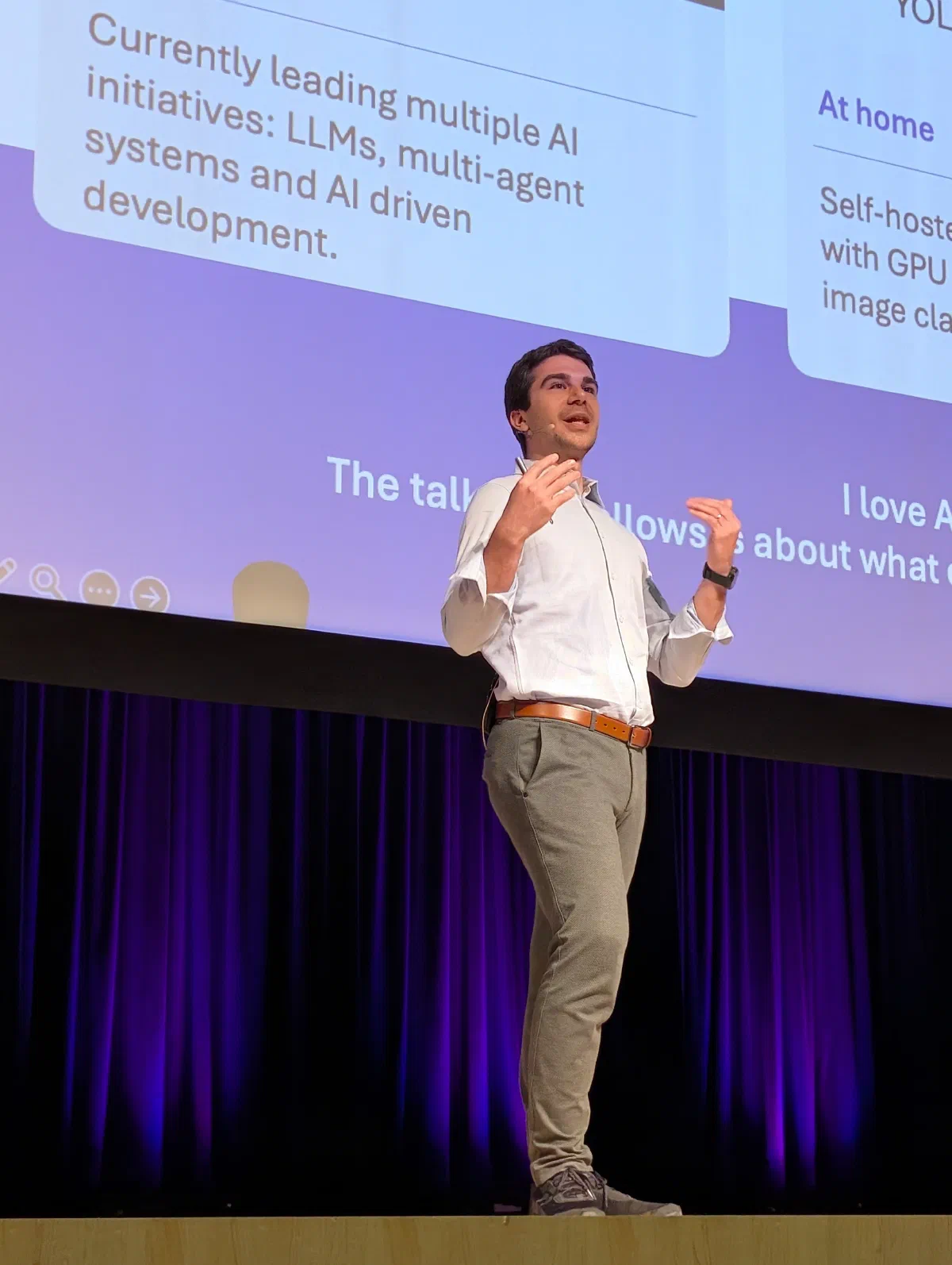
On May 7, I spoke at AI Summit Europe 2026 in Riga, in Ziedonis Hall, in front of an audience of around 400 people. Sharp questions, good hallway conversations, and a well-run event.
Abstract
According to MIT Media Lab (2025), 95% of generative AI (GenAI) projects fail to deliver measurable business returns. Not because the models do not work, they demo beautifully. They fail because organisations skip the fundamentals: clear requirements, stakeholder alignment, and product thinking.
In this talk, I challenge the “build a model first” mindset. The session explores why requirements engineering and understanding business value are more critical for AI projects, not less. Participants learn practical techniques to identify real value and collaborate effectively with stakeholders, defining success before writing a single line of code.
With this foundation, the talk examines when proofs of concept (PoCs) are actually needed and how to bridge the dangerous gap between a PoC and a minimum viable product (MVP). But it does not stop there: I ask what a real product strategy looks like and how organisations can move from one-off experiments to a systemic, transformational approach.
This talk helps the audience focus on getting value out of solutions, where AI is a powerful tool to achieve outcomes, rather than being the business value itself.
What I Covered
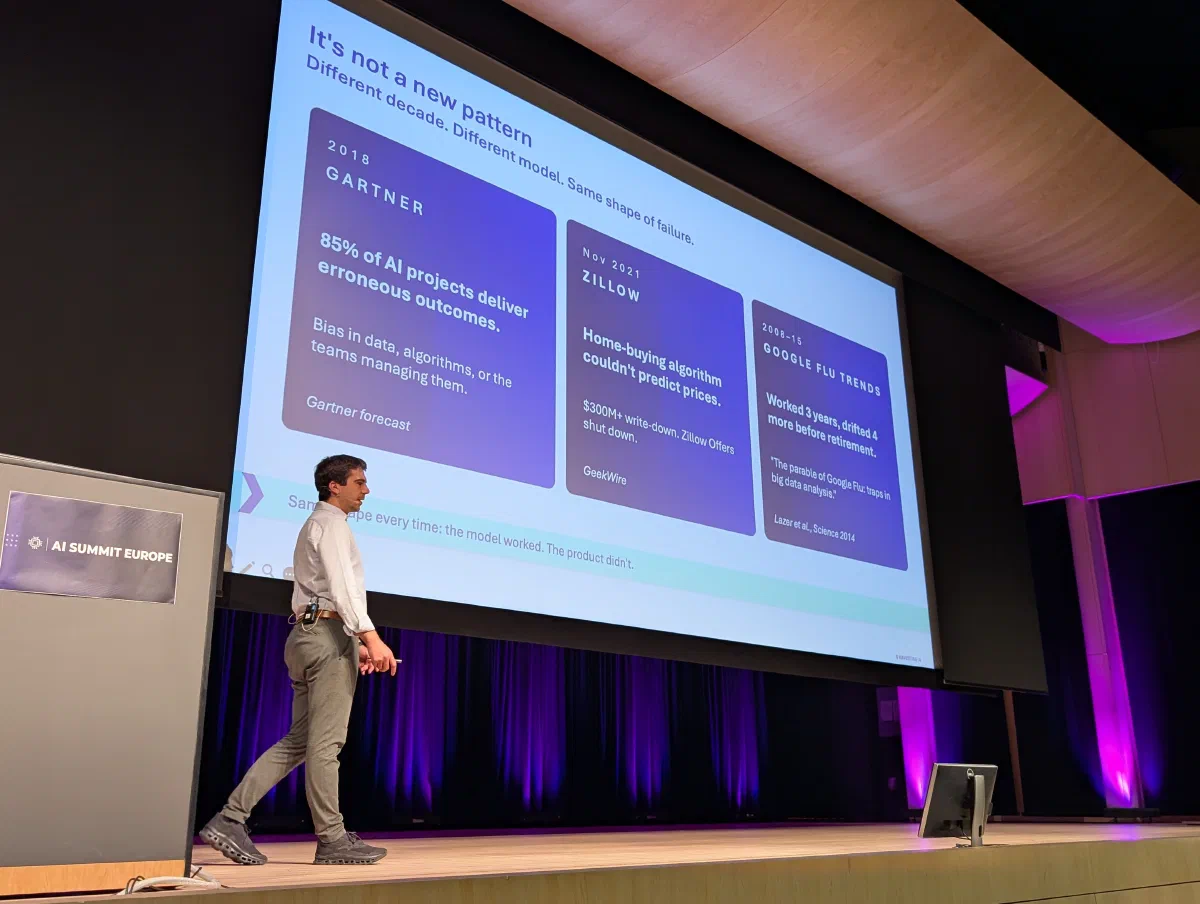
- It is not a new pattern. Gartner (2018): 85% of AI projects deliver erroneous outcomes. Zillow (2021): a $300M+ write-down because the home-buying algorithm couldn’t predict prices. Google Flu Trends (2008–2015): worked for three years, drifted for four more before being retired. Same shape every time: the model worked. The product didn’t.
- The model isn’t the problem. The undefined goal is. Many AI requests I get are not founded in business needs: no optimization target, no training signal, or no real bottleneck to optimize. No business value, no ROI, no happy customer.
- A rising metric is not proof of value. Goodhart applies: when a measure becomes a target, it stops being a good measure.
- From outside, AI changes nothing. The customer experiences a request going in and a decision coming out. They should not be able to tell where the AI is. “AI camera!” is marketing thinking. The product didn’t change.
- A framework to get from value to build. Three layers: Product (WHY), Domain (WHAT), Solution (HOW).
- Five phases that actually change as the product matures. Mock → PoC → MVP → Product Strategy → Scaled.
- A worked example: an online library. I ran the example through business model canvas, Wardley mapping, domain story, EventStorming, bounded contexts and context map, before asking the AI question at the end: where would AI actually help, and how would we measure it.
- “But agents do it for me now.” Three myths I pushed back on: an agent monolith is still a monolith; agents are themselves separated by roles, that’s what makes them precise; MCP is also an API, the protocol changed but the separation of concerns still applies.
Take Home
- Define the product before the model. If you can’t fill the product box or write the press release, you don’t have a product. From the outside, AI almost always changes nothing.
- Question the KPI before celebrating it. A rising metric isn’t proof of value.
- Distinguish marketing thinking from product thinking. Customers want outcomes, not labels.
Build products that happen to use AI, not AI that hopes to become a product.
The Audience and the Questions
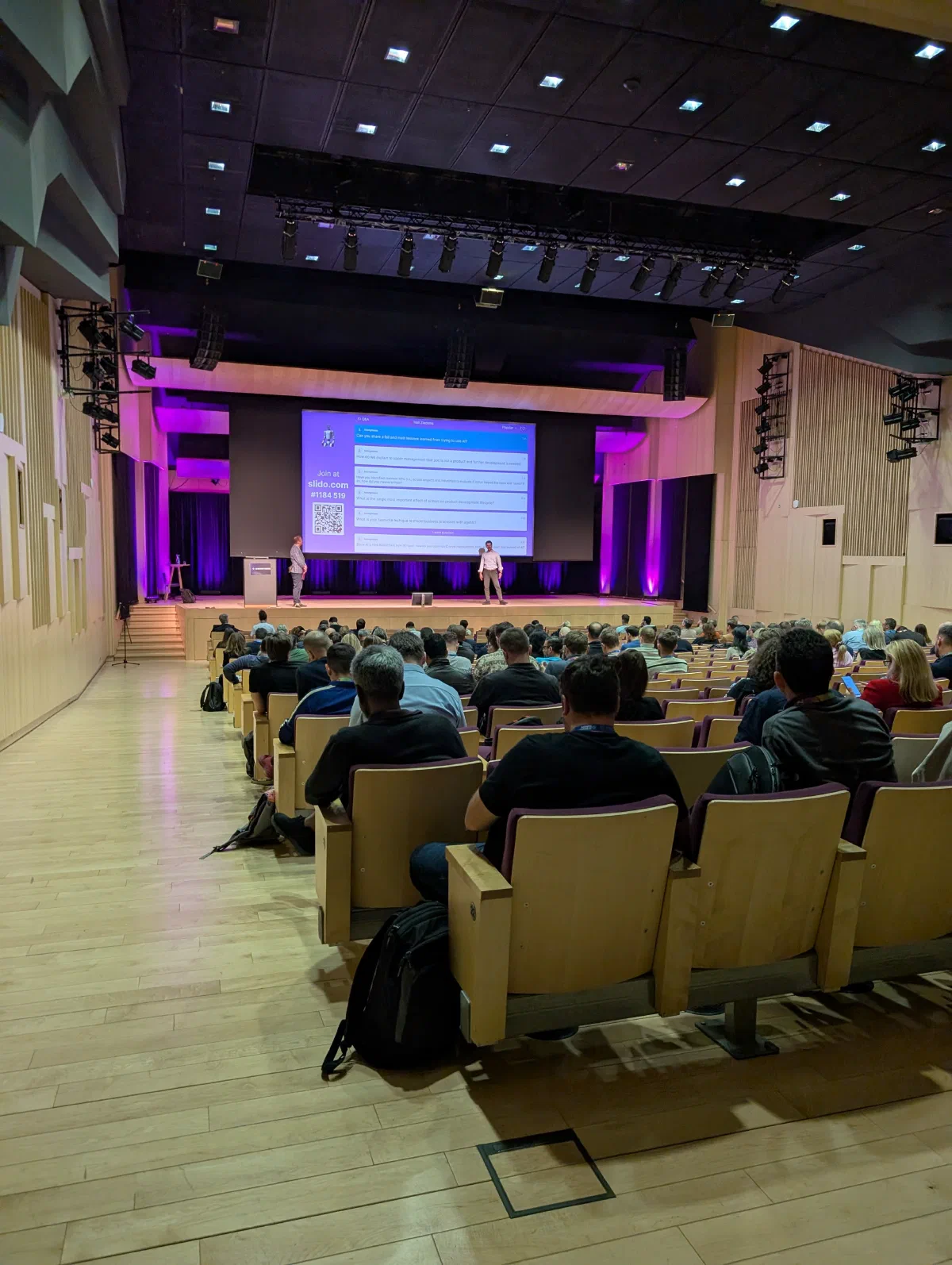
Around 400 attendees in the room, and the Q&A via Slido could easily have run another 20 minutes. The actual questions from the audience:
- Can you share a fail and main lessons learned from trying to use AI?
- How do we explain to upper management that a PoC is not a product and further development is needed?
- Have you identified common KPIs (i.e., across projects and industries) to evaluate if AI has helped the team with tasks? If so, how did you measure them?
- What is the single most important effect of AI tools on the product development lifecycle?
- …and many more
Audience Ratings
The conference organizers shared the audience feedback. Of all votes:
- 92.83% rated the session excellent or very good (positive)
- 6.6% rated it good or satisfactory (neutral)
- 1.1% rated it poor or very poor (negative)
The Conference
A great conference. Thanks to the organizers, the volunteers, and everyone who came up afterwards to continue the conversation.
Links and Resources
Connect:
Related Talks: